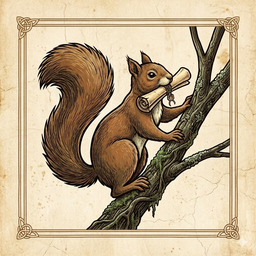
The old poems put a squirrel on the world tree. Ratatoskr runs the length of Yggdrasil, carrying word between the eagle at the crown and the serpent gnawing at the roots. He belongs to neither end. He is the one who travels both, and he is never at rest.
Here the roots are RATR's own chain, the ground the rest grows from. The crown is Alephium, whose name echoes Alfheim, the bright realm high in the tree. Other chains hang from other branches. The messenger's work stays the same; only the destinations change.
This is the first dispatch he brought down. It says what the coin is and every way in, each one the same weight. The chapters after it carry the steps.
What RATR is #
RATR is the coin of Ratatoskr, a proof-of-work chain of its own. Three things define it:
- Mined on ordinary CPUs. Blocks are found with yespower, a proof-of-work algorithm built for general-purpose processors.
- Masternodes. A masternode is a full node backed by RATR held as collateral in its owner's wallet. A regular masternode is backed by 7,500 RATR; an EvoNode by 30,000 RATR, with four times the voting weight. From block 25,000, every block pays one masternode, and the nodes are paid in turn.
- ChainLocks. Masternode quorums sign the tip of the chain as it grows. Once a block carries that signature, nodes reject any chain that conflicts with it, so it cannot be reorganised away.
These rules live in the node software, which is public. Read them at the source.
RATR and wRATR #
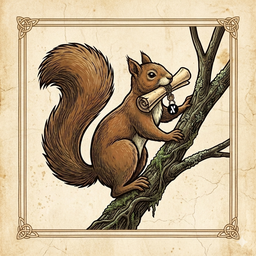
RATR lives on its own chain. wRATR is RATR carried to another chain by the Ratatoskr Bridge, one for one. Send RATR to the bridge and it arrives as wRATR. Send wRATR back and RATR is released.
wRATR is on Alephium, Base and BNB Chain. It is the same coin on each, and it moves between them over the same bridge. The bridge page shows its limits and confirmation times before you send anything.
ratatoskrbridge.enchantedforestdefi.com →
Bridges are covered in full in Chapter VI, Bridges.
The ladder #
Every door the same weight. Every stop temporary. The ladder below is the whole map: how RATR arrives, the places it works, and the one step that changes what the coin is. Chapters not yet carried down are named without a link.
How RATR arrives #
- Mine it with a CPU at a pool. It arrives as RATR. Chapter III, Mining.
- Buy it on the harbour with ALPH on Alephium. It arrives as wRATR. Chapter VII, Nóatún.
- Buy it on Base or BNB Chain. It arrives as wRATR. Chapter II, Get RATR.
- Earn it as a masternode payout. It arrives as RATR. Chapter IV, Masternodes.
- Bridge it from any of these to any other. Chapter VI, Bridges.
Where it works #
Each of these is a place the coin keeps moving. Each runs on its own terms, set out in its chapter.
- Stake wRATR in Yggdrasil Roots. Chapter VIII, Yggdrasil Roots.
- Provide liquidity on Nóatún and earn the LPs' share of the pool's fees. Chapter VII, Nóatún.
- Lock wRATR on Nóatún for a share of every fee and a vote on where the new wRATR flows. Chapter VII, Nóatún.
- Stake in Amber Hollow, where xALPH sits beside wRATR. Chapter IX, Amber Hollow.
- Keep mining. The CPU keeps adding. Chapter III, Mining.
- Hold it natively in a RATR wallet. Chapter V, Wallets.
The step that changes the coin #
At 7,500 RATR, a masternode opens. At 30,000, an EvoNode. Seven thousand five hundred is not a price. It is the point where a coin becomes a job.
The collateral stays in your own wallet the whole time. While it backs a node, the coin is no longer for sale: it is working. Chapter IV, Masternodes, covers running one, including hosted setup.
After the node #
Every block pays one masternode, and the nodes take their turns. Those payouts can go back through any door on the ladder, including toward the next 7,500 and the next node. The node pays the next node.
A node can also come back out. Spend the collateral and the node ends; the coin is free to re-enter the doors. Chapter IV, Masternodes.
Where to go next #
The chapters run in order, and each one stands alone. Start with the door you are standing at. Before any of them, Risk, plainly sets out what each part can and cannot guarantee.
- Already holding wRATR on Alephium: Chapter VII, Nóatún.
- Looking for contract addresses and how to read state: Chapter XI, Reference.
- Where live figures are shown and how to read them: Chapter X, Data.
- The Norse frame behind the names: Chapter XII, Lore.
- Everything else: the contents.
Carried down 2026-10-03. Chain rules are as written in the Ratatoskr node source on that date: proof of work in primitives/block.cpp, collateral in evo/dmn_types.h, the payment start in chainparams.cpp and the payee turn in evo/deterministicmns.cpp, ChainLocks in chainlock/signing.cpp and chainlock/handler.cpp. This chapter states rules, not snapshots: live values are on each site's own pages.